
Counting Scales
Why count parts by hand? It is boring, time consuming and prone to human error. Counting scales are the answer. They offer efficiency and elimination of high labour cost. The counting scale will pay for itself in no time. Before choosing a parts counting scale suitable for your operation, it is necessary to do a bit of homework. This is because in order to offer the best solution, we need to know the spread of weights which you need to count; sometimes it will be necessary to have more than one scale to get the best accuracy. |  |
Our selection of counting scales and industrial counting scales are precision weighing instruments built for British manufacturers, stockrooms, production lines, and warehouses. Whether you're counting fasteners, electronic components, small parts, or packaged goods, we've got a parts counting scale that eliminates the guesswork and gets the job done faster than any manual count.
Accurate, reliable, and straightforward to operate, our electronic counting scales turn weight into quantity saving time, reducing errors, and giving you confidence in every stocktake, kit, and despatch.


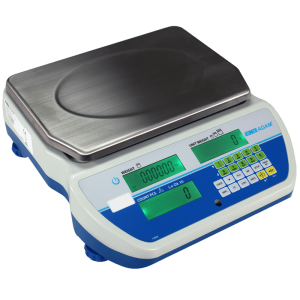
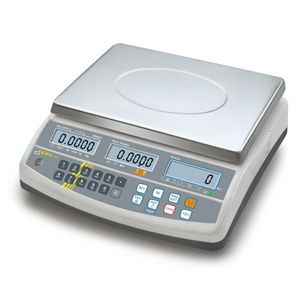

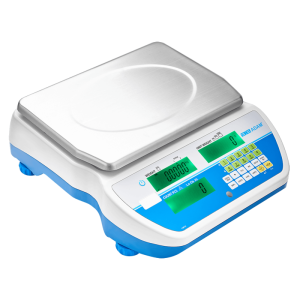
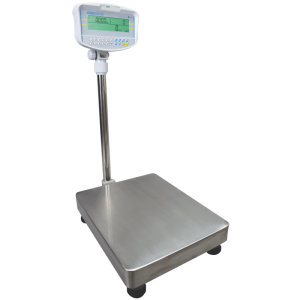
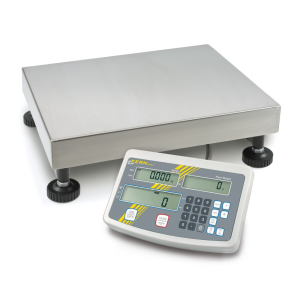
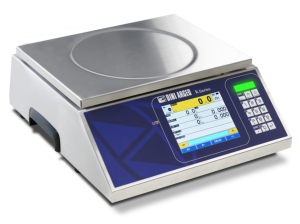
What Are Counting Scales?
A counting scale is a precision weighing instrument that calculates quantity from weight. Place a known sample of parts on the platform, tell the scale how many are in the sample, and it uses the average piece weight to count the remainder of the batch instantly, and without you handling a single extra component.
The principle sounds simple because it is. What separates a quality precision counting scale from a basic bench scale is the resolution of the load cell underneath. Counting small parts screws, washers, resistors, capsules demands fine readability, because even a small variation in piece weight calculation multiplies into significant counting errors at volume. Our industrial counting scales are specified with this in mind.
Types of Counting Scales
Compact Parts Counting Scales
Small, lightweight units designed for bench, counter, and stockroom use. These small counting scales handle the everyday counting tasks found across manufacturing, retail, and warehousing from fasteners and fixings to tablets and components. Easy to carry between locations, battery or mains powered, and simple enough that any operative can be up and running in minutes.
Best for: Workshop benches, goods-in desks, stockrooms, light manufacturing
Industrial Counting Scales
Heavier-duty platforms with greater capacity and higher-resolution load cells for production line and warehouse environments. Industrial counting scales UK manufacturers rely on handle larger batch sizes, heavier components, and the continuous use that a busy factory floor demands. Many models feature RS-232 or USB connectivity for direct output to inventory systems or printers.
Best for: Production lines, warehousing, manufacturing inventory control, goods despatch
High-Capacity Counting and Weighing Scales
For operations that need to count and weigh simultaneously verifying both quantity and total batch weight in a single operation. These weighing and counting scales suit applications where a discrepancy in either figure is a quality or compliance issue. Large platform sizes accommodate bulk counts of heavier components without sacrificing counting resolution.
Best for: Bulk kitting, hardware and engineering components, quality control checkweighing
Precision Counting Scales
Where piece weights are very small electronic components, pharmaceutical capsules, precision fasteners a standard counting scale may lack the resolution to distinguish individual items reliably. Precision counting scales use ultra-fine load cells, often with readabilities of 0.01g or better, to maintain counting accuracy even when individual piece weights are measured in fractions of a gram.
Best for: Electronics assembly, pharmaceutical counting, jewellery, micro-components
Remote Platform Counting Scales
A two-platform system with a separate counting platform and a large remote platform for bulk quantities. Weigh the sample on the precision platform; count the bulk on the remote platform. Ideal where individual piece weights are tiny but total batch quantities are large the remote platform handles the volume without losing accuracy on the piece weight calculation.
Best for: Large-batch small-parts counting, high-volume stocktaking, component kitting
How Electronic Counting Scales Work
The process on any electronic counting scale follows the same steps. Place a reference sample of known quantity on the platform typically 10, 25, or 50 pieces. The scale calculates the average piece weight from that sample. Remove the sample, place the full batch, and the scale divides total weight by average piece weight to display a count.
Accuracy improves with sample size. A sample of 50 pieces gives a more precise average piece weight than a sample of 10, which matters most when counting very light components where small variations in piece weight can compound into counting errors. Many of our industrial counting scales allow you to accumulate the sample progressively adding pieces to refine the average piece weight before committing to a count which is particularly useful for small parts counting scales handling ultra-light components.
Most models also support direct quantity entry useful for checking a known batch against a target count, or for setting packing quantities that the scale flags when reached.
Why Choose Industrial Counting Scales?
Speed that manual counting cannot match
A manual count of 500 mixed fasteners takes time, concentration, and is prone to error particularly late in a shift. An electronic counting scale returns the same result in seconds, every time, without fatigue. On a production line or in a busy stockroom, that difference compounds across every batch, every day.
Accuracy that protects your reputation
Short-kitting a customer order because a manual count was off by twelve pieces costs more than just the parts it costs credibility. Parts counting scales eliminate the counting variable, leaving only the quality of your component and the accuracy of your process.
Stock control you can trust
Inventory accuracy drives everything from purchasing decisions to production scheduling. Weighing and counting scales that integrate with your stock system via RS-232 or USB give you real-time quantity data without manual data entry and without the transcription errors that come with it.
Simple enough for any operative
Industrial counting scales UK businesses rely on day-to-day need to be usable by everyone on the floor, not just a designated technician. Clear displays, intuitive sampling sequences, and straightforward tare functions mean minimal training and consistent operation across shifts.
One scale, multiple applications
Beyond counting, most of our counting weighing scales support standard weighing, percentage weighing, and checkweighing functions. A single unit on the bench covers multiple tasks without needing separate instruments for each.
Choosing the Right Counting Scale
Piece weight and resolution
This is the critical specification. To count accurately, the scale's readability must be fine enough to distinguish individual pieces reliably. As a rule of thumb, your minimum piece weight should be at least five times the scale's readability, ideally more. For very light components, a precision counting scale with 0.01g readability is the right starting point. Our team can advise on the correct specification for your specific part.
Capacity
The platform needs to handle your full batch weight pieces plus any container or tray. If you're counting 1,000 steel bolts, the total weight on the platform may be several kilograms. Size capacity to the realistic maximum, not the average batch.
Sample size flexibility
Larger reference samples produce more accurate piece weight averages, particularly for light or variable-weight components. Look for scales that allow progressive sample accumulation adding to the reference count in stages rather than locking you into a fixed sample size.
Connectivity
If counted quantities need to feed into an inventory system, label printer, or PC, RS-232 or USB output is essential. Many of our industrial counting scales include these as standard; others offer them as options. Confirm your integration requirements before selecting a model.
Platform configuration
Single-platform scales suit most applications. For very small piece weights combined with large batch quantities, a remote dual-platform configuration precision platform for sampling, large platform for bulk counting gives you accuracy at both ends of the process.
Environment
Most counting scales suit standard workshop and warehouse conditions. For food, pharmaceutical, or washdown environments, look for stainless steel platforms and appropriate IP ratings. If the scale is being moved frequently between locations, battery power and a robust housing matter more than mains-only units.
Where Counting Scales Deliver Value
Manufacturing and assembly
Kit verification, component counting, and goods-in checking. Parts counting scales ensure every kit leaves with the right quantity of every part no short shipments, no over-issue, no production line stoppages caused by missing components.
Warehousing and distribution
Stocktaking, pick verification, and despatch checking. Industrial counting scales turn a laborious manual stock count into a rapid, accurate weighing operation. A bin of 2,000 washers is counted in seconds rather than minutes.
Electronics and precision engineering
Resistors, capacitors, fasteners, and precision components all demand accurate counts. A precision counting scale with fine resolution handles even the lightest components without losing counting reliability.
Pharmaceutical and laboratory
Tablet counting, capsule verification, and small-batch dispensing. Precision counting scales with GLP/GMP data output provide the audit trail that regulated environments require.
Retail and trade counters
Hardware shops, fastener suppliers, and trade counters use counting and weighing scales to serve customers quickly and accurately selling by quantity without counting by hand.
Coinage and tokens
Banks, gaming venues, and vending operations use coin counting scales to verify quantities rapidly. Purpose-built coin counting functions on many of our electronic counting scales handle standard UK denominations directly.
Why Choose Scalemart for Counting Scales?
We source our counting scales from established manufacturers including Kern, A&D, and Adam Equipment brands with a track record in precision industrial weighing. Every precision counting scale we sell is specified for its intended application, not just listed because it's available.
Our range covers the full spectrum of counting requirements from a compact small parts counting scale for a workshop bench to high-capacity industrial counting scales for production line integration. We stock counting scales for sale across a range of price points, with expert advice on specification included at no extra cost.
Key features across our counting scale range:
- High-resolution load cells for accurate piece weight averaging
- Adjustable sample sizes for improved counting accuracy
- RS-232 and USB connectivity for system integration
- Progressive sample accumulation for ultra-light components
- Standard weighing, percentage weighing, and checkweighing functions
- Battery and mains power options
- Stainless steel and IP-rated models for demanding environments
- Remote dual-platform configurations for large-batch small-parts counting
Every electronic counting scale we supply arrives tested, calibrated, and ready for immediate use.
Ready to Specify Your Counting Scale?
Call us on +448009154201 or use the live chat. Tell us your minimum piece weight, your typical batch size, your platform capacity requirement, and whether you need data connectivity we'll confirm the right counting scale for your application with no guesswork and no unsuitable recommendations.
This will depend to some extent on the value of the parts being counted; the more expensive they are, the more accurate you need to be. Scalesmart can help you here by offering to work this out for you. We offer a service whereby you can send in a representative sample of your parts, and we will accurately obtain the "average piece weight". We use the figures obtained to decide which is the best range of scales to offer.
It is most important to get this figure right, as it is used in the division process to display the count; quite simply, the number of pieces you have on the scale is worked out by dividing the net weight on the scale (after taking into account the container, which if used, is "tared off") by their average piece weight calculated by the scale. This calculation is obtained by placing a known number (say 10) on the scale, telling the scale there are 10 parts on it, and pressing the sample key; the calculation is then performed automatically and stored in memory From then on, the scale will show the number of pieces using the figures it has worked out. to weigh/count another part, you repeat the sampling process. The sample size required is determined either by calculation or by trial and error; it depends on the variation in average piece weight.
This need not be a daunting task however, as some of the parts counting scales have what is called "average piece weight enhancement". This is done by sampling the first 10, counting out 10 more using the scale to do this, and pressing the sample key again, whereby it will re-calculate using 20 parts; this will "enhance" the original figure (the more parts the better being the moral here) Scalesmart offer Kern & Sohn, Dini Argeo and Radwag counting scales specifically for counting parts.
Counting scales are not built solely for the purpose of measuring the weight of items, but are designed specifically to count items that you feed into the machines. These tools are used to accurately and quickly measure not only the weight of items, but also their quantity. These scales come in different forms and sizes, but all of them are made for a specificpurpose. Some counting scales are designed to measure solid articles by being placed on top of a pad, while some are made to measure the quantity of liquids.
Functions of Counting Scales
A counting scale may be used for several purposes such as to measure small or large quantities of different items. These may be used to count the exact number of coins, currencies, nails and other items by placing them on top of the pad that comes with these scales. A counting scale may be programmed to measure either the weight of the items or accurately count the number of materials. They can also be set to measure the unit weight of different items. There are a lot of businesses that make use of counting scales such as banks, pharmacies and other companies that sell items in large quantities.
Features of Counting Scales
These types of scales include large pads situated on top of the machine that is made to hold the different items that they will be counting. In the front area of the scale is a numeric pad used to calibrate the items as well as a display screen that will show the readout of the calculations. There are some smaller scales that include a limited memory for users to store samples of previous weights and can be retrieved for comparison for future quantity or weight measurements. Some scales may be battery operated while some make use of A/C adapters.
Counting Scales for Banks
One kind of business that are mostly benefitting from the use of counting scales are the banks. Nowadays, banks consider counting scales as one of the most important tools in their field. They use these scales to count currencies, coins and bank notes. In fact, a bank would not be able to function to its fullest without using counting scales. These measuring toolshave been continuously developed and improved by manufacturers, which resulted in these pieces of equipment becoming more sophisticated.
The modern counting scales enable tellers to simply put the bank notes and the currencies on the large pads on top of the machines and the scale will accurately count it for them. This makes the life of bank employees a lot easier, since they do not have to manually count the money. Take note that humans are more prone to make mistakes, so rather than have bank problems, they make use of these modern counting scales. Cash point machines in banks and other automated teller machines also make use of these counting scales. People who are depositing money or who are withdrawing from the ATM will hear the machine whirring as it counts and totals the money being deposited or withdrawn.
Counting Scales for Pharmacies
The field of pharmacy is another industry that relies and depends heavily on the use of counting scales. They use these weighing and counting equipment to make sure that the tablets or the pills being placed in the bottles are counted accurately and precisely. These counting scales are very sophisticated machines to ensure that the number of pills being placed into the bottles is exact with the weight measurement being accurate.
Counting Scales for any kind of Business
Counting scales are not only used in pharmacies or banks, but in almost any kind of business that are into selling things, food and other items. Bakeries make use of counting scalesto measure their food products equally. Manufacturing industries make use of these tools to ensure that each and every box or container that they ship out has the exact number of items that it should have. Even doctors, like pediatricians make use of these tools to accurately determine the rate of growth of infants and babies. Counting scales are not limited to these types of businesses and fields, even you as an individual can benefit from having one of your own.
Companies or businesses that are into selling things and items in quantity would hugely benefit from counting scales. In fact, this kind of counting equipment is already considered as a necessity for many types of industries. They do not only save a lot of time, they also save a lot of money and avoid problems that they would rather not deal with. Imagine people having to count nails manually in a place where a lot of machines are making noise. Imagine tellers having to count thousands and thousands of currencies or coins in the bank. This is not only time consuming, but is very frustrating as well.
Purchasing Counting Scales
There are a lot of counting scales that are currently available in the market. If you are thinking about purchasing one for your own business or personal use, it is important that you review and compare them from each other. Make sure that you are buying one from a reputable manufacturer or dealer. Check if the scale you are buying includes a warranty as well as a replacement policy. There are many factors to be considered in buying counting scales, but these are the most important of all that you should not forget to look for.

Shop By
Shopping Options